Alan Lennon – Raw, Real Emotion
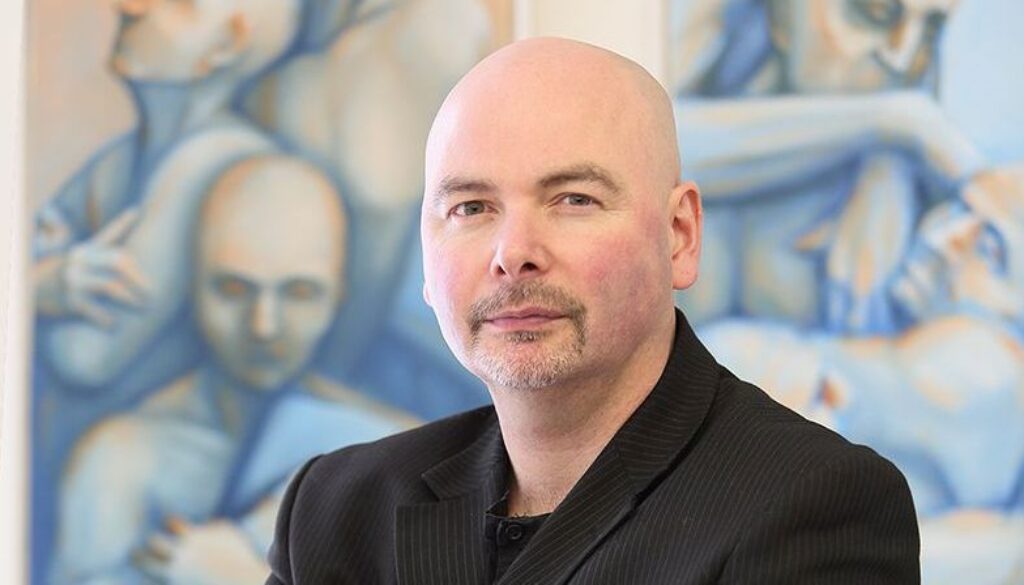
Colinton Arts spoke to Edinburgh resident, multi-disciplinary artist and graphic designer Alan Lennon [insert link to artist page] at his studio in Leith earlier this year. Lennon, softly spoken and calm, waxed lyrical about his life, career and influences.
Colinton Arts (CA): Tell us a little bit about yourself and your overall philosophy towards art.
Alan Lennon (AL): I was born in 1963 and punk was a huge factor in my formative years. I embraced the ‘do it yourself’ ethos; so if I wanted to play in a band or be artist, fine, I just went for it. I didn’t need anyone’s permission or come through the system. In fact, I didn’t study fine art, I studied illustration and graphic design – which is what I’ve done for the last 30 years.
CA: A bit of a rebel?
AL: So yes, a bit of a rebel for all that… It’s always been there; I’ve kept it going! My wardrobe is entirely black. I don’t drive. I was in my mid 20s, a mature student with a family, before I went to college to study graphic design but that mature head was good for me.
CA: Yet you didn’t start up a full-time art career until relatively recently?
AL: I was always going to do something but that was frustrated because I set up a contract publishing agency, myself and a colleague, which became quite successful. Within seven years we had grown from two to a dozen people. The downside of that was that I was a victim of our success, I didn’t have the time or headspace to pursue my art. Instead of being a designer I became more a people and project manager. In 2008, after many years, I stepped away from it, sold my part of the business and set up again on my own as a designer. That allowed me then to paint as I wanted. My wife, Elaine believed in me and got me my first studio – a Portakabin in Out of the Blue Studios for my 40th birthday or something, and at that point I started to take it seriously, my art that is.
CA: Okay, thanks for that. I’d like us to think a little bit from the perspective of the pieces that you’re showing in our gallery.
AL: If I reflect on a particular theme or interaction between the art and the viewer, there is underlying something very personal that I don’t shout about. I suffer from anxiety and depression, and if you were to scratch the surface of the paintings you would be able to expose that. That’s possibly why I’m very quiet and introspective like my works. It’s probably overthinking everything, yeah, there is an element of me in them all.
So, I’m trying to create very much an open narrative and people can interpret them anyway they feel. It’s all valid.
CA: There seems to be a connection between the ways in which you hope your art will be interpreted that seems very similar to music and lyricists.
AL: So, the music, yeah in the sense that songs have personal meaning for individuals so they can overlay their own experience.
CA: The singer Michael Stipe from REM said “You don’t need to know what my lyrics are about. It’s what it means to you.”
AL: Yeah, I would agree with that, I just create an expression. It’s up to you to add your own interpretation and you identify with what it is that speaks to you. One of the things that I dislike in the art world today is some kind of super academic who goes on to explain what this work or that work is about and what the artist was thinking. I think it’s enough if you can use your creativity to help express yourself and connect with the viewer without the need for an essay to accompany it. I’m always developing, evolving, and I think that’s because you’ve never actually happy with what you’ve achieved. You’re always editing.
CA: Coming back to the pieces that we’re exhibiting, what can you tell me about them?
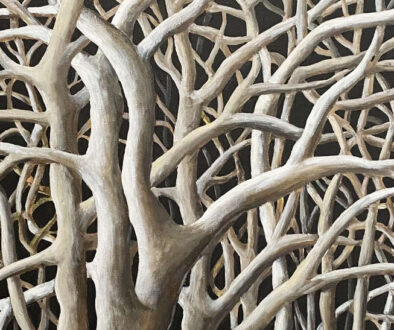
AL: My ongoing themes reflect introspection, self-isolation or alienation. You can tell all the people who come to the gallery that I’m showing some of the story of my ongoing evolution, from my early seminal work which became later quite sculptural and moving towards a more simplified semi abstracted figurative style. This is me experimenting and my ongoing challenge is to keep the humanity and quiet spirituality of my early work but stripped down to more simple geometry.
CA: You keep coming back to music.
AL: I feel connected with music. I love it and that’s inspired, as you say, some of the themes that come through in my art. Thinking of that, the poetry and raw real emotion of bands like Joy Division, The Cure, reach out to me. Nothing else feels like that. My drinking buddies are Nick Cave, Leonard Cohen, Tom Waits, Johnny Cash… My melancholic music choice might not be your taste and that’s kind of similar to a lot of the art world for me. It might not be your cup of tea, okay. Another bloody highland cow or a seascape? For some people that’s great, but it won’t make me happy. I’m not being judgemental… No, all I’m saying is it doesn’t touch me, Pop Idol music doesn’t touch me. Yeah, I think it is all about the work. about expressing the human condition. It’s about how you can try and channel your inner feelings.
CA: Alan Lennon, thank you.